NEAR AI Cloud on SayGm: The Verifiable Confidential Inference Stack

NEAR AI Cloud's confidential inference is now available through SayGm, an AI gateway for teams who need more than a privacy policy.
Table of contents
- What is SayGm?
- SayGm's three model tiers
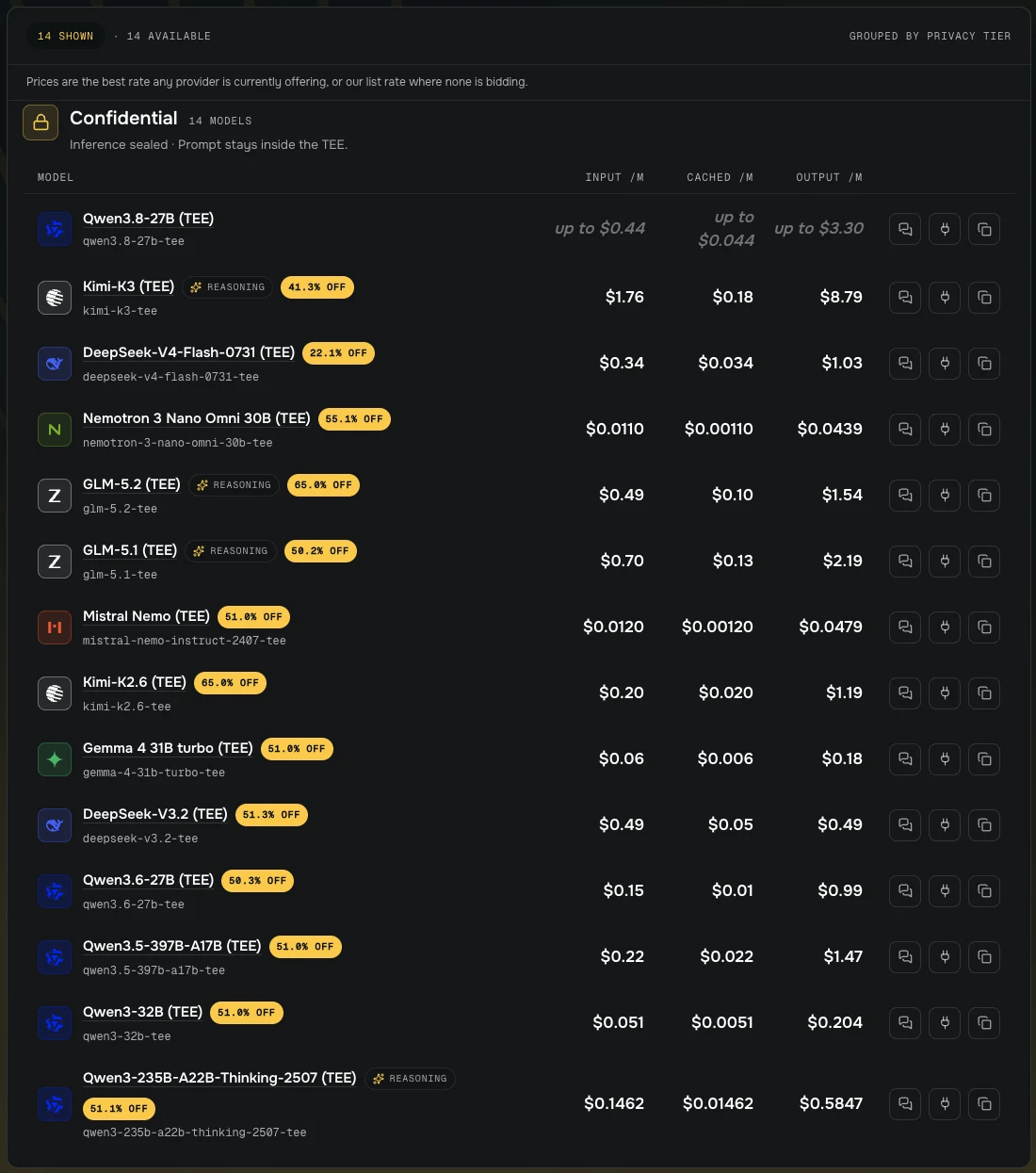
- NEAR AI confidential models on SayGm
- How to verify confidential inference with NEAR AI
- Frequently asked questions
What is SayGm?
SayGm is an AI gateway that reaches dozens of frontier and open-weight models through a single API key.
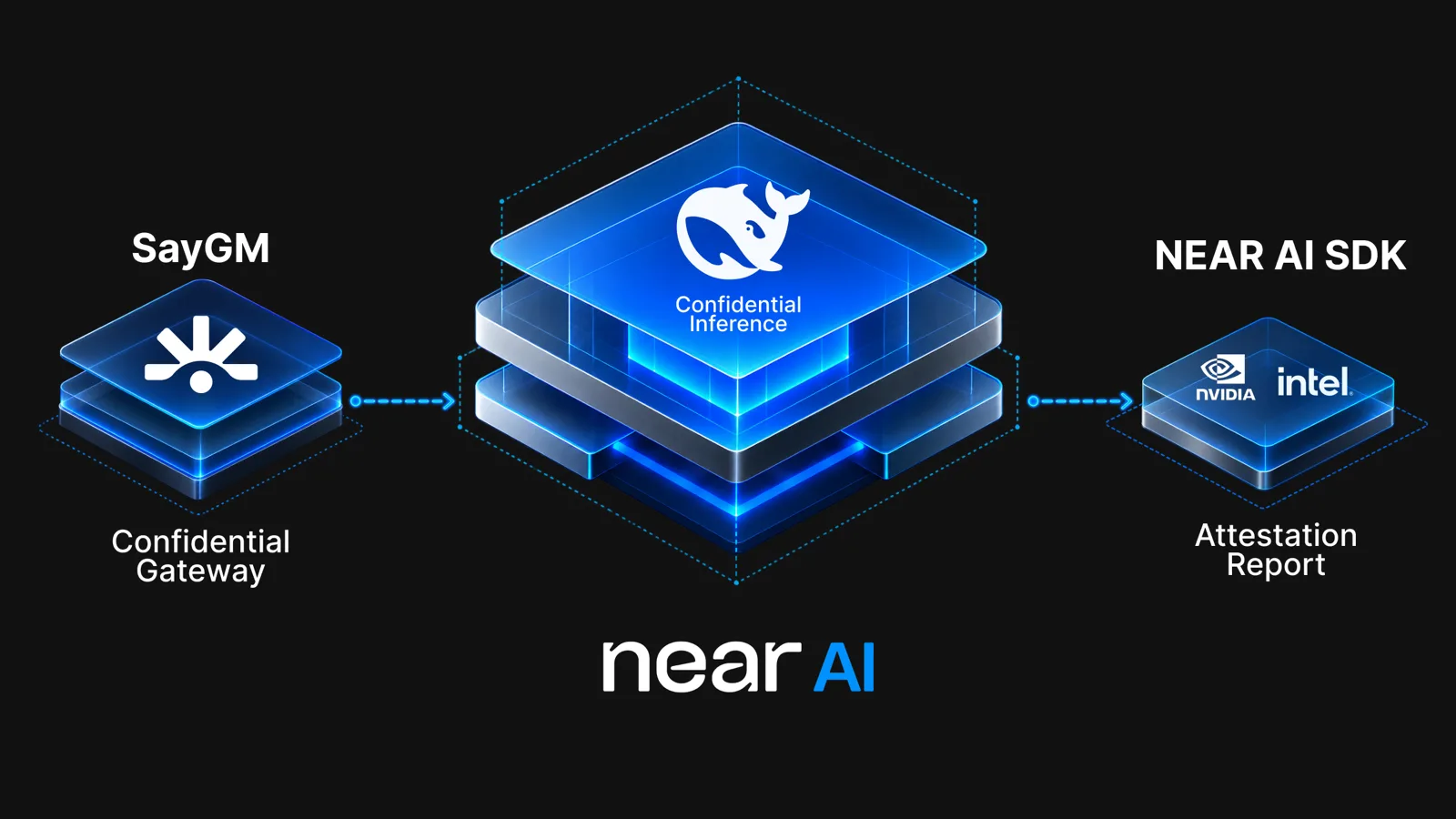
What separates it from other gateways is where the routing happens. SayGm runs its own gateway inside an Intel TDX enclave, so your prompt is decrypted inside protected hardware rather than on an ordinary server. The operators running the gateway are not able to read what passes through it, which is a stronger statement than a promise not to look.
SayGm uses prepaid credits rather than a subscription, so you pay for the usage you need across every model in their catalog.
That design is why the route fits. SayGm protects the gateway. NEAR AI Cloud protects the environment running the model, and hands you an attestation report to check it. Teams protecting proprietary code, customer PII or unreleased work get a path where neither company is in a position to read the work, enforced by hardware and cryptography.
SayGm's three model tiers
The SayGm catalog is organised in three tiers, and the tier is the field that answers the privacy question.
- Frontier: closed-weight models like Claude or GPT. Requests go to an upstream provider, and that provider's policy governs your data.
- Confidential: open-weight models where inference stays inside a trusted execution environment. Confidentiality is enforced by hardware rather than by policy.
- Open: open-weight models too, but served by a provider that is not running a TEE. They are not verifiably confidential.
But a field naming who built a model tells you nothing about who processes and sees your data. Kimi, DeepSeek and Qwen weights all run in several places under very different guarantees.
If you care about keeping your company's alpha, go with the AI models listed in the confidential tier.
NEAR AI confidential models on SayGm
NEAR AI Cloud runs open-weight models in Intel TDX virtual machines paired with NVIDIA GPUs in confidential-computing mode. Encrypted connections terminate inside the enclave rather than at a load balancer, so prompts are never in the clear on a machine any operator could reach.
Or, in simpler terms, when you run your inference with NEAR AI's confidential AI models, you get a hardware-signed report describing exactly what environment your work ran in — a privacy claim you check rather than take on trust.
As of this writing, NEAR AI Cloud's catalog includes open-weight models such as:
- DeepSeek V4 Flash and DeepSeek V4.1 Flash
- GLM 5.3 Flash
- Kimi K2.6 and Kimi K3
- Several Qwen 3.x variants, including a vision-language model
For teams evaluating privacy-first gateways, using NEAR AI models via SayGm links two independent trusted execution environments, giving developers cryptographic verification across both the router and the underlying compute stack.
To see all of the models offered by NEAR AI Cloud, including the ones listed in SayGm, visit our catalog.
How to verify confidential inference with NEAR AI
You do not need an account or an API key to request a NEAR AI attestation report. Run this before your first request:
NONCE=$(openssl rand -hex 32)
curl "https://dsv4-flash.completions.near.ai/v1/attestation/report?signing_algo=ecdsa&nonce=${NONCE}"
The report names the loaded model, carries evidence from Intel and NVIDIA, and returns the nonce you generated, which is what makes it fresh rather than captured earlier. Verify the Intel evidence with the open-source dcap-qvl library and the GPU evidence through NVIDIA's Remote Attestation Service. The verification path runs through Intel and NVIDIA, not through us. Reports are free and never count against usage. Add include_tls_fingerprint=true and the certificate fingerprint is bound into the report, proving the TLS key is held inside the enclave rather than by something in front of it.
One limit matters. The report proves what a NEAR AI enclave is running when you ask it. It does not prove that one particular request through a gateway reached that enclave. If you need that link for an audit, ask for a per-request record.
If you would rather read code than prose, NEAR AI publishes reference implementations of the full verification flow. The NEAR AI Cloud Verifier is the more complete of the two.
Read our docs.
Frequently asked questions
What is confidential AI inference?
Confidential AI inference runs a model inside protected hardware, so prompts and outputs stay inside a trusted execution environment for the whole request. The chip signs a report describing the code that ran, which means the privacy claim is something you check rather than something you are asked to believe. Standard inference decrypts your prompt on a machine the operator administers, and the only protection is that operator's policy.
Is confidential inference more expensive than regular inference?
Not necessarily. Confidentiality does not have to carry a premium, and our aim is a current roster of leading open-weight models with no privacy tax attached. Compare for yourself in our pricing.
What is a trusted execution environment (TEE)?
A TEE is a hardware-isolated region of a chip that keeps code and data encrypted while they are running, not only at rest or in transit. It is also called a secure enclave. NEAR AI Cloud runs open-weight models inside Intel TDX virtual machines with NVIDIA confidential GPUs, and the hardware signs a report describing exactly what was loaded, which is what makes the environment verifiable rather than merely claimed.
What does SayGm's confidential inference tier mean?
It means the open-weight model runs inside a trusted execution environment, so the prompt stays in protected hardware through inference. That is different from the frontier tier, where requests leave for an upstream provider under that provider's terms, and from the open tier, where an open-weight model is served outside a TEE. On the confidential tier the guarantee comes from the serving environment, which is why the tier, rather than the model name, is the field to check.
Can I verify the environment before using it?
Yes. NEAR AI serves an attestation report without an account or an API key. Read our verification docs.