
Verifiable privacy is a prerequisite for user-owned AI. Most prompts today run through third-party inference providers that can access your inputs at runtime: your financial data, medical questions, product ideas, business strategy, internal research. All that information is exposed during execution.
Today, Venice and NEAR AI are integrating to change that. Venice users now have the option to use verifiably private text and image models where nobody, including the infrastructure provider, can see the data at all.
The Privacy Problem Today With AI Inference
When you send a prompt to most APIs, it travels in plaintext through systems that can access it. Even if providers don’t store data, your prompt is still visible at runtime. It can pass through logging systems, monitoring tools, and internal infrastructure layers. Every modern AI workflow assumes that the provider handling your request is behaving correctly: that they are not logging, inspecting, or misusing your data.
For basic use cases and at a small scale, that assumption is merely uncomfortable. But in agentic workflows, such as agents managing credentials, automating decisions, running sensitive pipelines, acting fully on your behalf, the stakes change. That level of exposure becomes a structural vulnerability. You are no longer sending isolated prompts. You are leaking how you think, how you reason, and how your systems operate.
Until now, there has been no real way around this. You either accepted the tradeoff, ran everything locally, or avoided using AI for sensitive work entirely.
What Venice and NEAR AI are now introducing is a different architecture. Instead of trusting the system, you can verify it.
How Your Data Stays Private With Venice and NEAR AI
In Venice’s standard architecture, your conversations are encrypted in your browser and never stored on Venice’s servers. The GPU processing your request can see the plaintext of that specific conversation—but not your history, and not your identity.
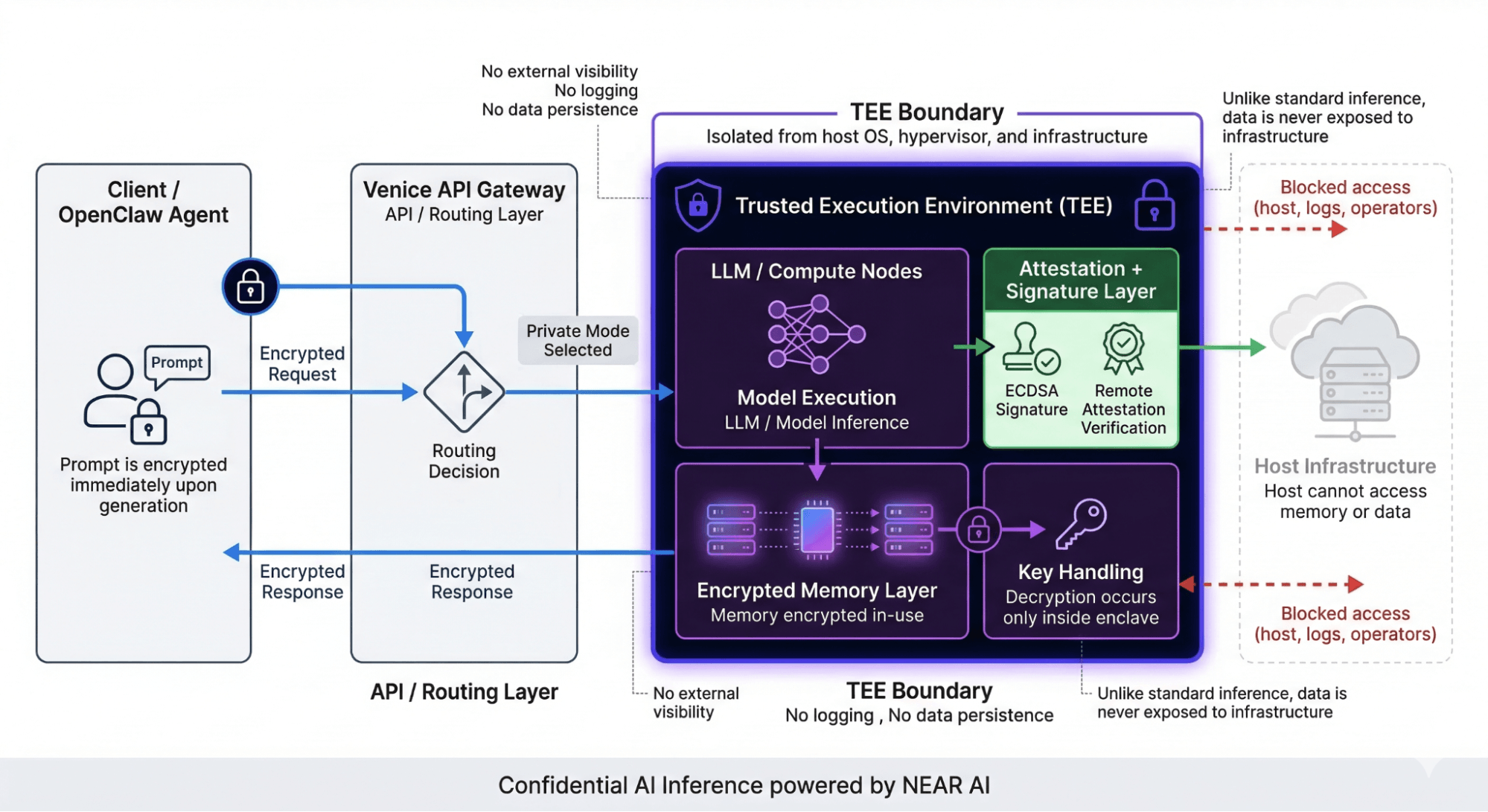
NEAR AI private inference removes that final exposure. Your request is routed into a secure enclave known as a Trusted Execution Environment (TEE)—a hardware-isolated partition of the processor that is sealed off from the host operating system, the cloud infrastructure, and any external process. The GPU provider sees nothing. Neither does NEAR AI or Venice.
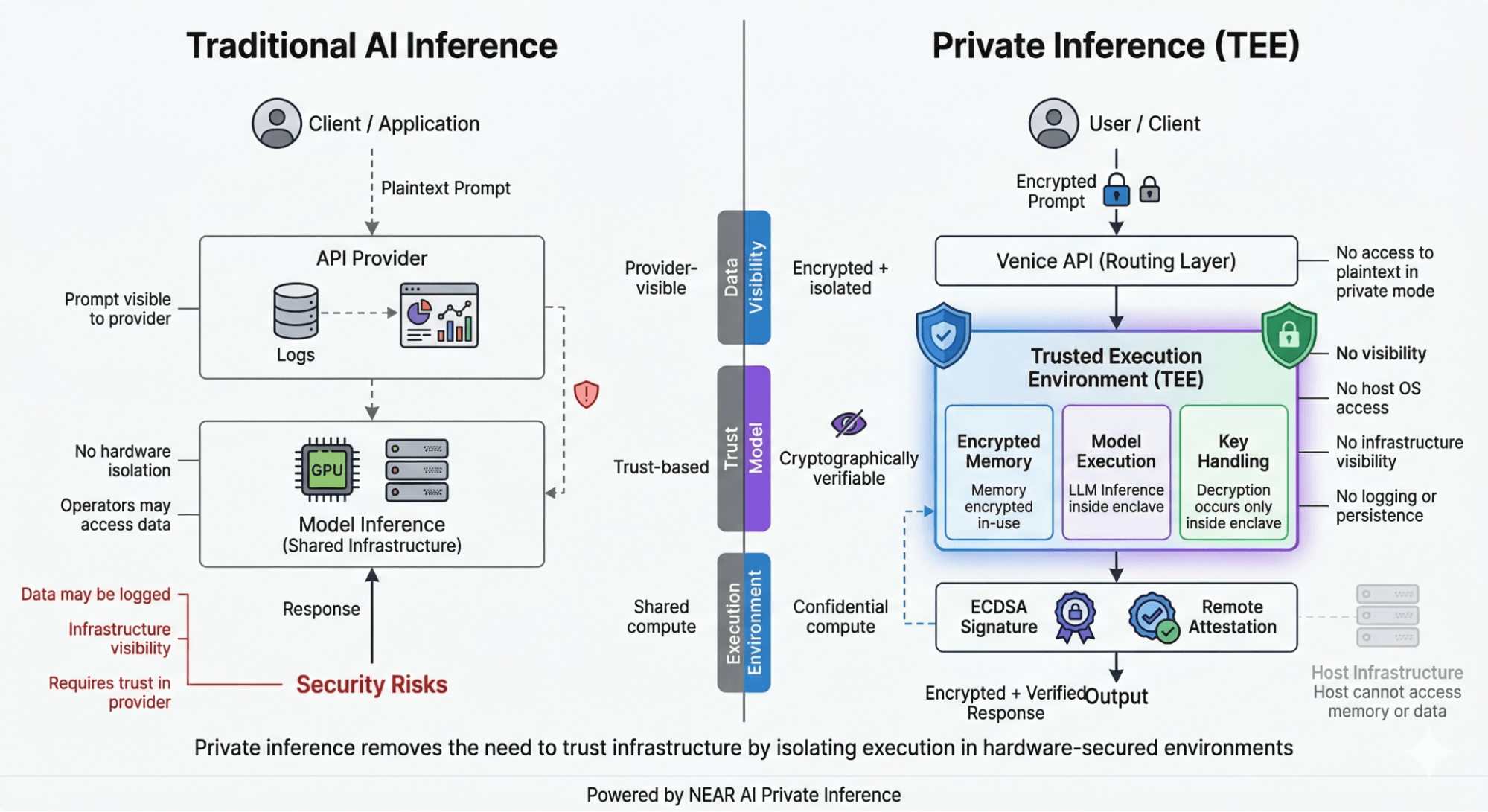
Inside this environment, your prompt is decrypted only within the enclave, the model runs in isolation, and memory remains encrypted during execution. No external system can access the data. Not the cloud provider, not the operating system, and not the engineers running the infrastructure.
Once the model completes its work, the output is returned securely and cryptographically signed.
What makes this architecture so powerful is that users can verify this themselves. NEAR AI provides attestation and signature verification, allowing you to confirm that your request was executed inside a secure environment and that the response was not tampered with. This replaces blind trust with verifiable guarantees.
“The most sensitive thing you’ll ever share is how you think. Venice was built on the conviction that no company or government has any business being in that room. NEAR AI’s confidential inference makes that conviction cryptographically verifiable on Venice.”
— Erik Voorhees, Founder & CEO, Venice
“As AI moves from answering questions to taking actions, the privacy of the inference layer stops being a preference and becomes a requirement. You cannot build a resilient agentic economy on infrastructure that requires you to trust the provider. NEAR AI is that infrastructure—and Venice is proof.”
— Illia Polosukhin, Co-Founder of NEAR Protocol and Founder of NEAR AI
Try Verifiably Private Inference on Venice Today
For the first time, the most critical layer of the AI stack, model execution, no longer depends on trust and assumptions about how the provider will behave. Venice and NEAR AI replace the assumption of provider trust with cryptographic proof. That distinction is the foundation the agentic economy needs to be built on. Venice and NEAR AI are building it now.
Venice is now integrated with NEAR AI’s confidential inference infrastructure. Enable private inference today at venice.ai.
To learn more about NEAR AI’s confidential inference infrastructure, explore https://www.near.ai.